
How the Moti Physio 3D Posture Scan Works
The Moti Physio system is an advanced, non-invasive assessment that uses 3D imaging and intelligent analysis to evaluate your posture, alignment, and movement patterns with precision.
Widely used by physiotherapists and movement specialists, it provides a detailed, data-led view of how your body is functioning—highlighting imbalances, compensations, and areas for improvement.
The result is clear, objective insight that removes guesswork and forms the foundation for targeted, effective treatment and correction.
3D-Capture Technology
Instead of X-rays or markers on the body, Moti Physio uses markerless 3D scanning technology — often an RGB-D sensor (a camera that captures both colour and depth information) combined with AI algorithms.
Here’s what happens:
Infrared depth sensing detects the outline and contours of your body.
The system combines front, side, and back views to create a full 3D model of your posture.
The AI interprets this data in real time to calculate posture angles, symmetry, and alignment deviations — for example, forward head position, shoulder tilt, pelvic rotation and spinal curvature.
This process happens quickly — often within 30 seconds — and it’s completely safe because there’s no radiation involved.
Static vs. Dynamic Analysis
Moti Physio doesn’t just capture a single snapshot — it offers a comprehensive assessment:
Static Posture Analysis
You stand still while the scanner captures your body shape and alignment.
The software measures angles and deviations at key landmarks (like head, shoulders, pelvis), showing where you might be off balance.
Dynamic Movement Tests
In some protocols, you perform simple functional tasks (for example, an overhead squat or a single-leg balance test). These tests reveal how your posture functions under movement and can show compensations or instability.
AI-Driven Analysis & Reporting
Once the scan is complete:
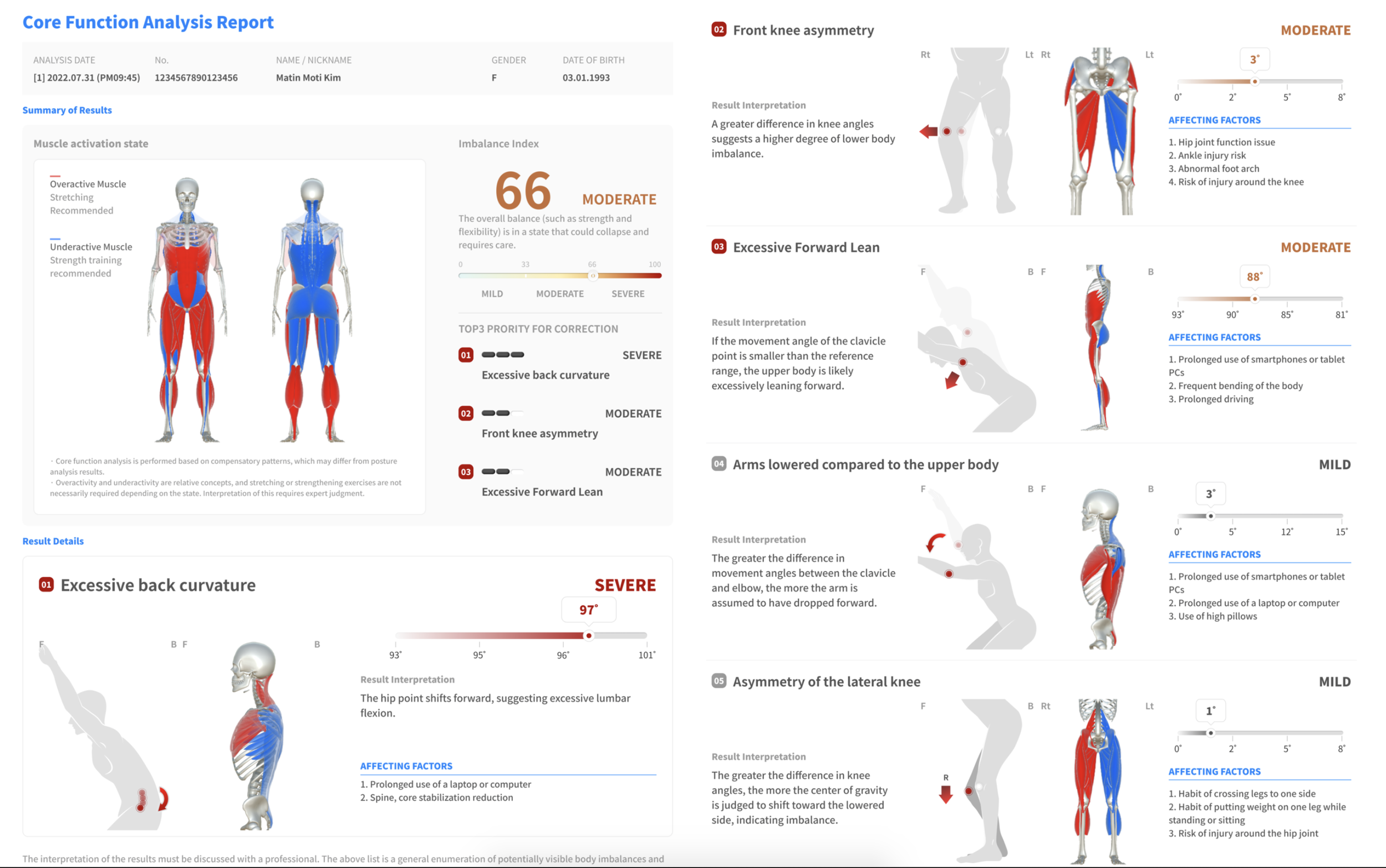
An AI engine processes the 3D data and compares it to normative patterns, generating a report that highlights key imbalances.
Results may include muscle imbalance insights (e.g., tight vs. weak muscles) and quantified angles showing deviations from ideal posture.
You can view results as visual models, 3D skeleton views, or colour-coded muscle maps that make it easy to understand where issues lie.
What the 3D Posture Scan Measures
Typical measures include:
Spinal alignment (e.g., kyphosis, lordosis, lateral shifts)
Joint deviations at the head, shoulders, pelvis and lower limbs
Muscle asymmetry patterns
Balance and movement control in dynamic tests
Outcomes and Benefits of using the 3D Posture Scanner
After scanning:
Clients receive a detailed posture report they can review with a clinician or trainer.
Data supports personalised therapy or exercise planning to address specific postural issues.
Follow-up scans track progress over time and help adjust corrective strategies.
Summary of how the Moti 3D Posture Scanner works
Moti Physio’s 3D posture scan works by:
1. Capturing a 3D body scan with depth-sensing cameras.
2. Using AI to measure posture deviations and muscle imbalances.
3. Providing visual reports and metrics for clinical interpretation.
4. Supporting both static and dynamic posture and movement analysis.
It’s fast, markerless, radiation-free, and designed to give objective, actionable data that goes beyond simple visual assessment.
Here’s a simple, client-friendly breakdown of what a typical Moti Physio 3D posture scan session looks like from start to finish, focusing on what the client actually does during the assessment.
-
At the start of the session, the clinician explains the purpose of the scan and what it will assess, such as posture, alignment, balance, or movement patterns. The client is reassured that the scan is non-invasive, radiation-free, and quick. Any questions are answered before starting.
-
The client is asked to stand barefoot or in flat shoes, depending on the clinic’s protocol. Tight-fitting clothing is recommended (for example, shorts and a fitted top) so the system can clearly identify body contours and joint landmarks. No markers or sensors are attached to the body. The client then stands in a designated scanning area in front of the 3D camera system.
-
For the static assessment, the client stands still in a natural, relaxed posture—not “trying to stand perfectly.” Arms are usually placed comfortably by the sides.
The scan takes only a few seconds.
The camera captures the body from multiple angles (front, side, and back).
During this time, the client simply remains still and looks straight ahead.
The system records body alignment, symmetry, and posture angles automatically.
-
If the assessment includes movement analysis, the clinician will guide the client through one or more simple functional movements. These may include:
Squatting
Single-leg balance
Arm raises
Forward bending or reaching tasks
Each movement is demonstrated beforehand. The client performs the movement slowly and naturally while the system records how the body moves in 3D. These tasks help identify compensations, balance issues, or movement asymmetries that may not be visible in a static posture.
-
Once all scans are completed, the client can relax and step away from the scanning area. The entire scanning process typically takes 5–10 minutes, depending on the number of tests performed.
-
The software processes the data almost immediately. The clinician then reviews the results with the client, using:
3D body visuals
Alignment measurements
Colour-coded indicators of imbalance or asymmetry
This visual feedback helps the client clearly understand their posture and movement patterns.
-
Based on the findings, the clinician discusses recommendations such as corrective exercises, physiotherapy treatment, ergonomic advice, or training modifications. The scan also serves as a baseline, allowing future scans to track progress over time.
The Moti Physio Scan is designed to be effortless from the client’s perspective
Simply stand naturally, follow a few guided movements if needed, and receive clear, easy-to-understand results in minutes. The process is quick, non-invasive, and completely comfortable—giving you precise insight into your posture and movement, without guesswork or complexity.